
Model Style Is So Cringe
What it teaches us about writing and alignment
A model can produce the rhetoric of argument before it has fully specified an actor, a relation, a limit, or a claim.
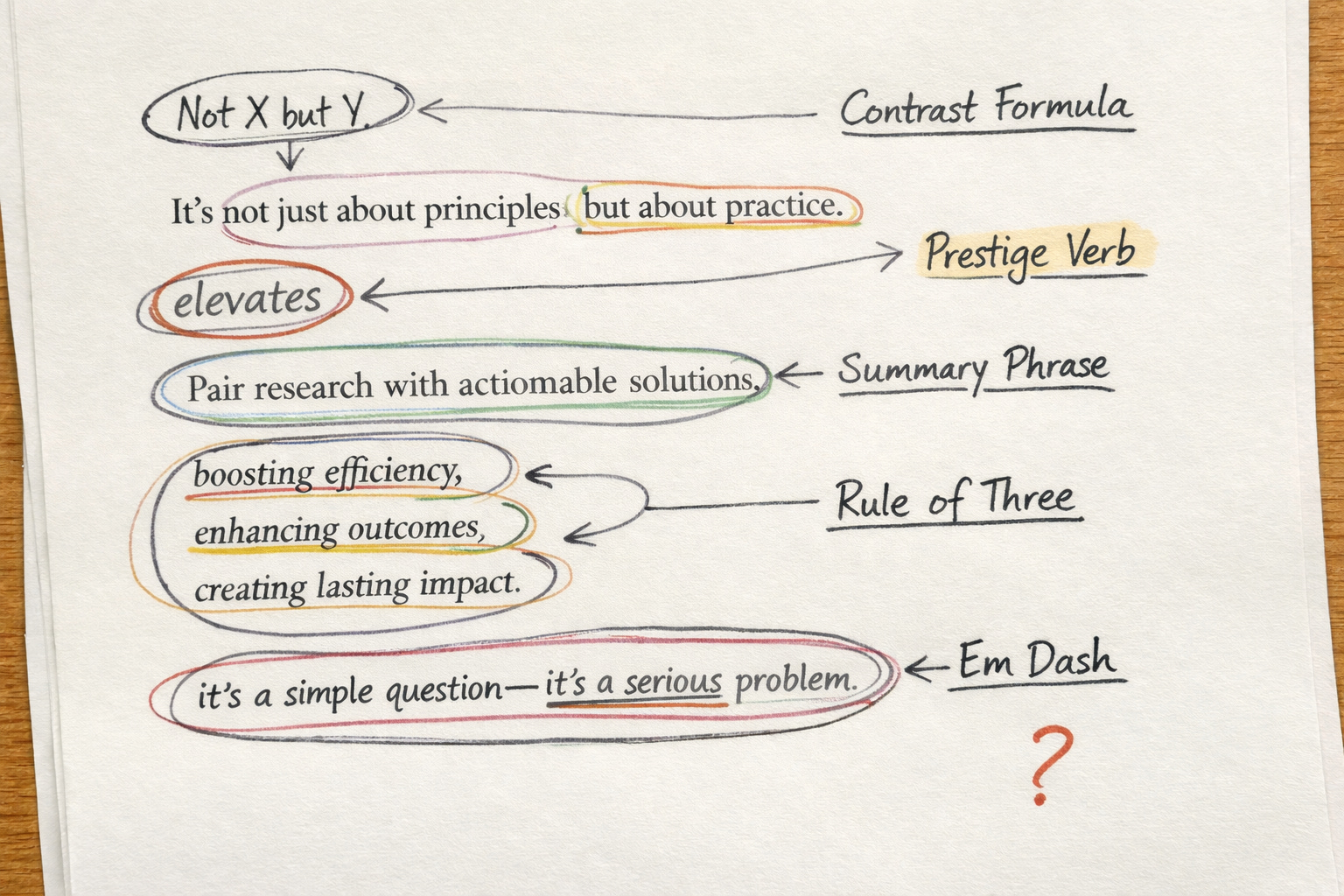
Overheard in class
Student One: Models have ruined em dashes for me.
Student Two: Yeah, I use em dashes to dodge punctuation questions.
Student One: I think the model does this too. But em dashes are great for pausing and creating emphasis.
Student Two: Models emphasize everything. Maybe just lay off, you don’t want to get clocked.
The classroom exchange captures two frustrations at once: models have cheapened certain stylistic moves, and students now hesitate to use them. Trained on style guides, blog prose, corporate uplift, and every sentence that sounds as if it aspires to be quoted on LinkedIn, models have flattened many once-useful writing styles, overusing them to the point of numbing repetition. Recent research suggests that some model style results from alignment itself. Tom Juzek and Zina Ward argue that alignment can reward small lexical signals of authority strongly enough that models begin to overproduce them, turning mild evaluator preferences into conspicuous stylistic habits. At the sentence level, that tuning produces a familiar set of effects. The em dash begins to signal syntactic evasion. The rule of three begins to sound prefab. Negative parallelism, “not this, but that,” turns every point into a reveal. Inflated verbs like delve and highlight, or cringy prestige ones like elevates, resonates, and carries dominate ordinary prose, so a student writing about medical ethics suddenly sounds as if she were describing a tasting menu: “pairing ethical reflection with actionable policy pathways.”
These habits have become obvious enough that readers now identify them on sight. Across blogs and newsletters, people remark on the deadening obviousness of model style, detecting its habits at the level of sentence, rhythm, and tone. In his AI as Normal Technology Substack chat, Arvind Narayanan comments on model style:
“The real sign of AI writing is not superficial stuff like ‘It’s not X—it’s Y.’ It’s the hollowness. Polished writing but relatively mundane ideas…. Reading text that has the syntactic smell of AI is mildly annoying, but when I read hollow writing I feel the writer is wasting my time.”
Becky Tuch describes that hollowness at the sentence level: inflated openings, mechanical contrast, canned redemption arcs, piled-up fragments, and the overmanaged pulse of prose that is always trying to sound quotable. For a teacher, though, the practical question is how to teach students to write after these once-useful devices have been overused into vaporous model output.
Students often know when a phrase sounds like model prose, but they still reach for it when they struggle to hear a better sentence. My son, who reads college applications, joked this admissions cycle that he was tempted to publish a list of “model-style howlers” to warn applicants away from them. I notice the same thing when I read AI ethics conference papers or grant proposals. Certain phrases, cadences, and transitions now signal borrowed seriousness. Observing the problem across these settings changed how I taught.
For some of my international students, the issue is even more complicated. When I warn them away from model language and point out the repeated cadences, some answer that this is how they learned to write academic English. They draw on forms of mastery they have been taught to trust. That response has made me more careful. Models intensify a preexisting academic register full of abstractions, prestige phrasing, and overgeneralized transitions. When we look closely at that language together, these students often find effective, concise styles of their own.
I realized that the better lesson was to practice hearing when a stylistic device works: when it makes a clear claim or points to a precise relation. An em dash can narrow a broad statement into its exact point: “The clinic failed its patients — it discharged them without translation support.” A rule of three can organize distinct claims: “The system excluded some patients from care, delayed treatment for others, and hid both failures behind one average score.” A contrast can clarify an actual distinction: “Access and trust are different problems: one concerns entry, the other reliability.” The goal is to help students use these devices deliberately, so that style strengthens argument and sharpens evidence.
The next danger is overcorrection. A student who removes every marked stylistic choice in order to avoid sounding like a model has let the model set the terms anyway. The better question is whether the sentence needs the device. Students improve when they practice asking what the thought requires, whether the syntax clarifies the relation, and whether the emphasis comes from the idea or from a borrowed pattern.
Why are these habits so easy to hear in model prose? A predictive system favors transitions, emphases, and sentence shapes that work across many contexts, so it reaches quickly for familiar cues of seriousness such as contrast, cadence, uplift, and summary. A human writer may begin with a point and build a sentence to communicate it. A model can produce the rhetoric of argument before it has fully specified an actor, a relation, a limit, or a claim. Bender and Koller help explain the deeper issue: models can reproduce the form of argument without grounded understanding. Bill Lin and his coauthors find that post-training changes show up most strongly in stylistic tokens such as discourse markers and safety disclaimers. If alignment rewards prose for sounding coherent, helpful, and well managed, the model will keep returning to the same signals of coherence and helpfulness. That is one reason model prose falls back on the same formulas across very different topics. For students, that exaggeration becomes instructive. It makes vague actors, abstract verbs, manufactured contrast, and inflated claims easier to notice. Studying model style can sharpen students’ sense of when style clarifies thought and strengthen their command of how to use stylistic moves in their own writing.