
Berkeley Law’s New AI Policy Gets the Problem Right and the Pedagogy Wrong
A blanket ban purchases clarity at the cost of understanding how students already use AI.
UC Berkeley School of Law’s new AI policy addresses a serious pedagogical concern for all of higher education: students can use generative AI to bypass the tasks that teach judgment. When students read difficult material, weigh evidence, build claims, and revise their own arguments, they learn to reason responsibly.
In an effort to protect the characteristically slow and difficult human labor of learning, the Berkeley policy prohibits AI use for “conceptualizing, outlining, drafting, revising, translating, or editing” any work submitted for credit. It also bars AI use in exams and forbids students from uploading course materials into generative AI systems. Students may use AI only for the limited purpose of identifying possible sources, and they remain responsible for verifying those sources.
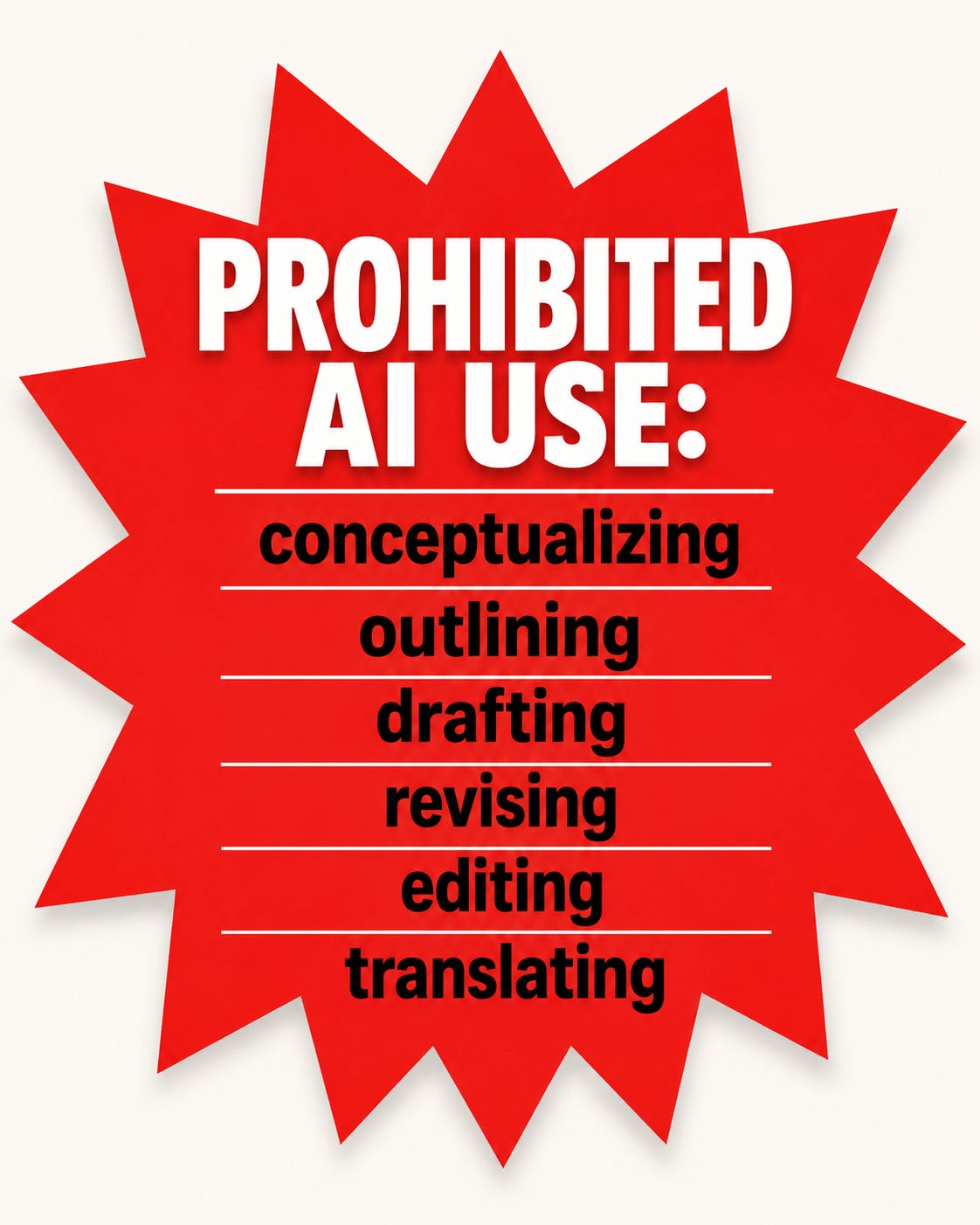
The policy bans many now common AI support strategies. A student may not ask AI to brainstorm a topic, propose an organizational structure, summarize a legal rule, identify repetitive passages, correct grammar, translate a paper into English, or generate an exam outline. Chris Hoofnagle, Faculty Director of the Berkeley Center for Law & Technology, has defended the policy arguing AI has transformed questions of academic integrity into a crisis of cognitive labor.
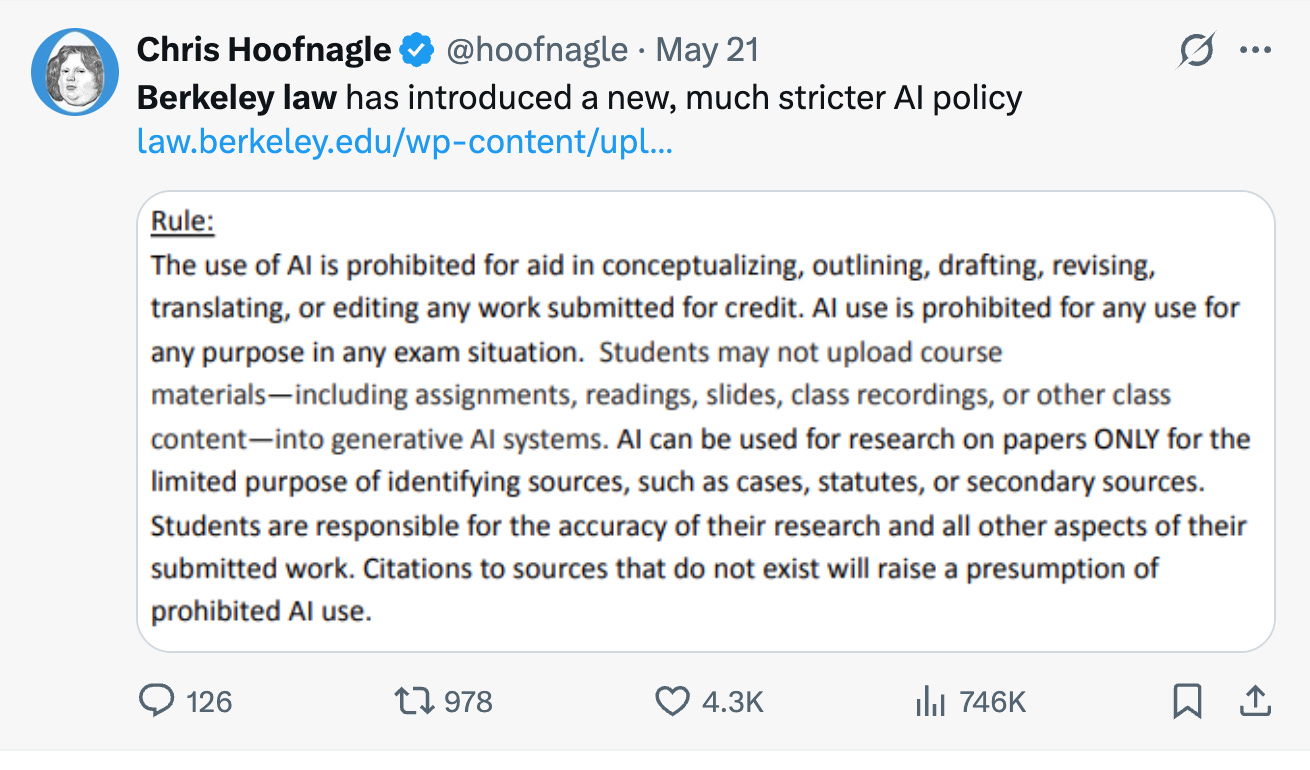
Hoofnagle defends the policy asserting it allows students to use AI for tutoring or self-study outside work submitted for credit, and instructors may authorize different uses in courses designed to teach AI fluency or where a different rule is pedagogically justified. This concession offers less help than it appears. For students, the most consequential academic uses of AI often occur at the boundary between practice and submitted work: understanding the assignment, generating possible approaches, testing an outline, comparing a draft to a rubric, locating unclear sentences, or receiving language support before revision. When those uses are permitted only outside credit-bearing work, the policy preserves a narrow space for tutoring while removing many of the support practices through which students actually learn to produce better work.
Berkeley’s policy offers a clear and universal response to reports of widespread cheating, which appeals to instructors seeking a standard they can explain concisely and enforce. But it purchases clarity at the cost of understanding how students already use AI, where they need support, and how higher education might teach responsible use more fairly. A student who asks AI to generate a thesis, choose authorities, organize an argument, or produce prose for submission has bypassed the work the assignment is designed to teach. A student who asks AI to read directions aloud, generate practice questions, explain a confusing passage, compare a draft to a rubric, or flag where a paragraph becomes unclear may still be doing the intellectual work.
Research on AI-supported writing supports this more differentiated approach. A 2026 study by Kim, Lee, Detrick, Wang, and Li found that students succeed when they learn to use AI without surrendering judgment. A broad ban derails that learning opportunity and raises an accessibility problem. Students use AI to manage barriers universities already struggle to address: delayed feedback, unclear expectations, stigma around disclosure, difficulties with sequencing or attention, and uneven access to informal academic help. A policy that bans grammar support, translation, task parsing, or revision feedback may appear even-handed because it gives all students the same rule. But students enter college with different language backgrounds, disability statuses, levels of preparation, confidence, and access to tutors, editors, family members, or professional networks. In that context, visible support can be mistaken for dependency, while less visible support remains unregulated.
Recent education research strengthens this point. A 2025 scoping review of GenAI for neurodivergent students found promising uses, including personalized learning, real-time support, feedback, administrative assistance for educators, and individualized education planning. The review also addresses problems of over-reliance on models, privacy concerns, and the need for guided, disclosed, purpose-specific uses that preserve teacher judgment and student responsibility.
Even Hoofnagle’s own example points beyond a blanket ban. In his X post, he refers to OneTutor. Well-designed systems can support learning when they function as access, practice, or feedback: they can read directions aloud, break an assignment into steps, ask students to explain their reasoning, generate practice questions, identify confusing sentences, or help students compare a draft to a rubric. Those uses help students see what they understand, where they are stuck, and what they need to practice next. These examples show why enforcement should not be the starting point. First define the work students must do themselves. Then decide where AI can support that work without replacing it. These questions require instructor labor, but so does policing AI use. Better to spend that labor teaching AI’s limits than chasing its use.
Berkeley’s policy responds to a real moment of institutional alarm. AI allows students to evade work, fabricate reasoning, and submit prose they cannot defend. A strict ban offers a clear response to that danger, and many instructors understandably value rules they can explain and enforce. But administrative clarity can derail the harder inquiry higher education now requires: how students and faculty are already using AI, and where those uses compromise or support learning.
Independent thinking has never meant thinking without support.
Defenders of the Berkeley policy hope it will preserve independent thinking. That goal is worth protecting, but independent thinking has never meant thinking without support. Students think with books, notes, teachers, editors, peers, outlines, examples, and feedback. For neurodiverse students, support tools for attention, sequencing, memory, reading, or written expression may be more visible, but visibility is not dependency. The better policy begins by defining the work students must do themselves. Then it decides where AI may support that work without replacing it.